Relocation
Moving abroad with a dog: why the flight becomes harder than the move
In an international move, the dog is the only part of the household with his own deadlines, his own paperwork and his own window. Why that inverts the planning — and how to put it back in order.
An international move is a long list of things that can be pushed. The container can sail a week later. The furniture can go into storage. The bank account can be opened remotely, the lease signed by video, the notice period stretched by a month.
And then there's the dog.
He is the only part of the household with deadlines of his own. His rabies vaccination has an expiry date. His official veterinary certificate is valid for a handful of days. His import permit runs from a date of issue, and it was applied for against a window you had to fix before you knew when the landlord would sign.
Which is why, at some point, the planning inverts. The moving date doesn't determine when the dog flies. When the dog can fly determines the moving date.
The dependency nobody schedules
In most relocations this only becomes visible late, because each individual step looks harmless on its own.
The visa depends on the employment contract. The housing depends on the visa. The dog's import permit requires details that have to be settled. The official vet's certificate is issued shortly before travel and lasts only days — so the appointment can't be made as a precaution. And the flight itself, assuming the dog gets a place at all, has to fall inside exactly that window.
Move any one of those by a fortnight and all of them may move. That is the moment an administrative process turns into an emotional one.
The return leg gets forgotten
People plan the journey out. Almost nobody plans the journey back — and in regulatory terms that one is often harder.
An example: for a dog returning from the United Arab Emirates to the EU, what matters is how the EU classifies the country. The UAE appears in Annex II of Implementing Regulation (EU) No 577/2013 as a listed third country. The practical consequence of that classification is probably the most important single fact in this article: for animals that have been exclusively in listed countries immediately before entry, a rabies antibody titration test is not required. From a non-listed country it would be — with a blood draw, a laboratory and a waiting period.
That is a detail with substantial consequences, because it decides whether a short-notice return is possible at all or whether it needs months of lead time. Anyone planning to move between two countries, or wanting to keep the option of coming back, should know this before flying out.
And like everything regulatory, it can change. Check the classification for your travel date, not for the year you emigrated.
The gap between two homes
There is a phase that appears in no guide and that almost everybody lives through: the time between handing back the old place and moving into the new one.
For people that's a hotel. For a dog it's a question. Where does he sleep once the furniture has gone and the new flat isn't ready? Who takes him if you have to fly ahead to sign papers? And how long can that interval last before it becomes the real burden for the animal — more than any flight?
This is where the option many people choose and few discuss comes in: the dog follows later. With friends, with family, in boarding kennels, sometimes for weeks.
It is a legitimate solution, and for some animals it is the right one. It just deserves to be named honestly. What you're deferring isn't a task. It's a separation — and the person who ends up organising the paperwork is by then already in another country.
Why the route comes first
The usual order is: move, then find a flight for the dog.
With a dog over eight kilograms that rarely works. Whether the journey can happen at all is decided by conditions outside your calendar: the airline's animal policy, heat embargoes in certain months, whether the route exists as a direct flight or only with a connection, and whether that connecting airport can through-check animals in the hold.
So it pays to turn the question round. Not: when do I move, and how do I get the dog there? But: in which weeks is a journey possible for this dog at all — and where can I put everything else?
That order feels wrong. It also spares you the situation where the flat is ready, the contract has started, and the dog has no route.
It is exactly what one guest described after moving to Dubai in 2025: her relocation nearly failed on finding a way to fly her dog. Not on the visa, not on the housing — on the question of how a pug gets to the Emirates.
The paperwork belongs to one person
One organisational detail causes more delays in relocations than almost anything else: who is responsible?
In a move that stretches over weeks, with one person flying ahead, tasks distribute themselves almost inevitably. One takes the dog to the vet, another filed the application, a third — friends, family — brings him to the airport on the day. The papers then live in three households, and everybody knows half the deadlines.
But authorities and handling agents work from a file, not from an understanding between people. If a vaccination doesn't match the chip number at the check, or a certificate is one day too old, it doesn't help that somebody else knew about it.
So decide early who runs the document chain — one person, with every original and every date. Everyone else supports. It sounds bureaucratic for a family matter. It is the difference between a journey that happens and one that fails on a date nobody was watching.
What's waiting at the other end
Arrival isn't the end of the organising. It's the second half of it.
In the United Arab Emirates dogs are registered locally; responsibility sits with the individual emirate and procedures differ. In the search for housing, building rules have a vote: not every building allows dogs, and towers allow them less often than villa communities. Settling that before signing is cheaper than settling it after.
And then the climate. Summer temperatures regularly pass 40°C. Daily life shifts to the edges of the day — walks before sunrise and after sunset, tarmac still hot into the evening, water always within reach. For dogs who regulate heat poorly, that is the real adjustment, not the flight.
It helps to know that before leaving. Not to alarm anyone, but because a routine is easier to plan than to improvise.
What the dog takes from all this
A change of perspective to close on, which oddly makes the whole thing simpler.
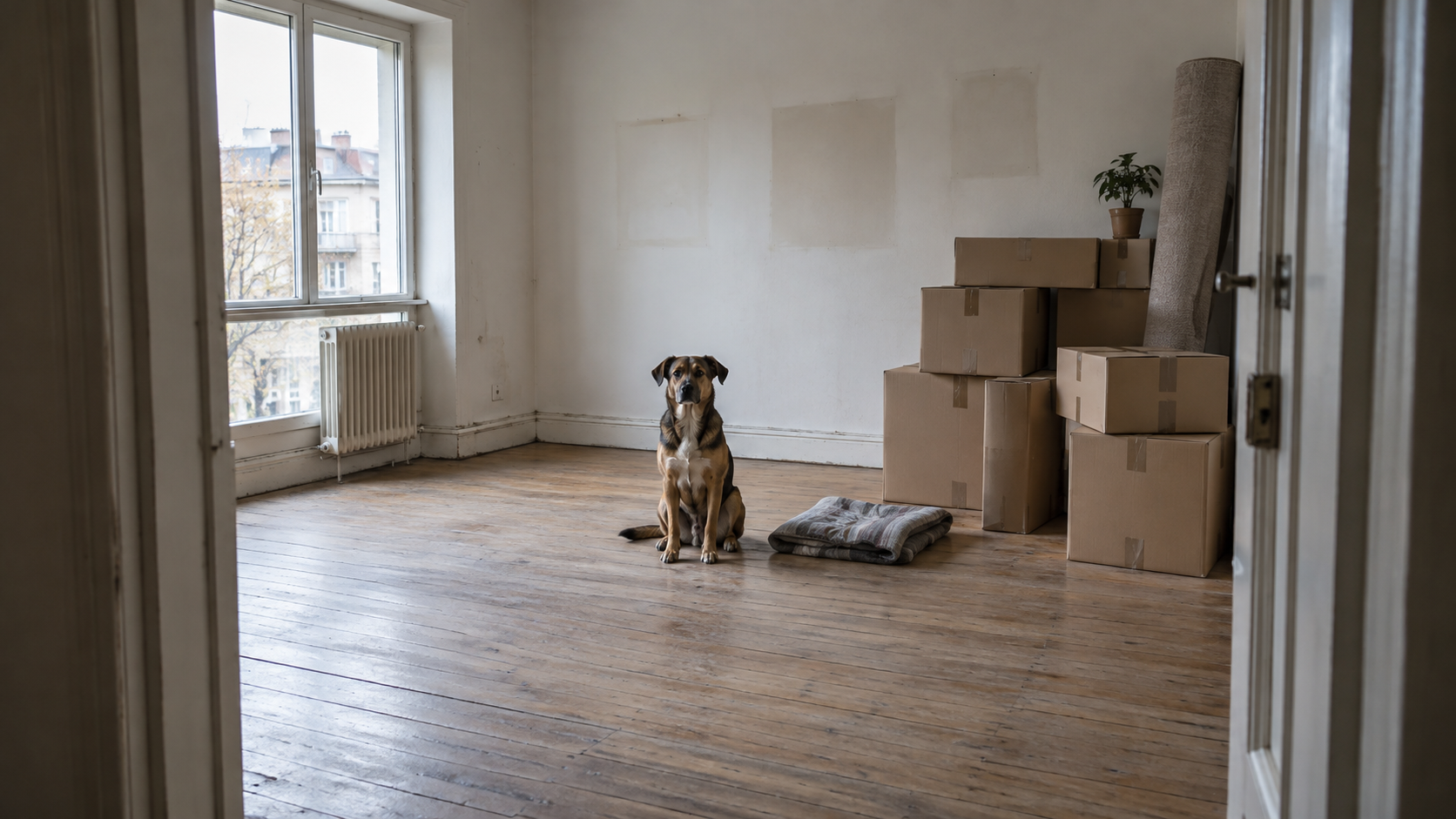
For you, emigrating is a process spread across months: notices, authorities, goodbyes, half a life in boxes. For your dog it consists of very few events. The flat empties. There's a car journey. Perhaps one unfamiliar night. Then a day on which a great deal happens. And after that, a new place with his blanket in it.
What he measures is not the distance. It's whether you're nearby.
That isn't sentimentality; it's a practical yardstick. It sorts out what you're actually investing in with this move: speed, comfort — or how many hours this animal spends alone inside a system he doesn't understand.
Put it that way once and the decisions come faster afterwards. Not necessarily cheaper. But with considerably less doubt.
Map the window first
If you know where you're moving but not yet when: tell us the route and a rough timeframe. We'll tell you in which weeks a journey is realistic for your dog — before you arrange everything else around it.