Private aviation explained
One aircraft, several travellers: how jet sharing actually works
Shared private flights are priced per seat, not per aircraft. How a route comes into being, how it differs from charter and from scheduled flying, and why dog owners turn out to be an unusually logical travel community.
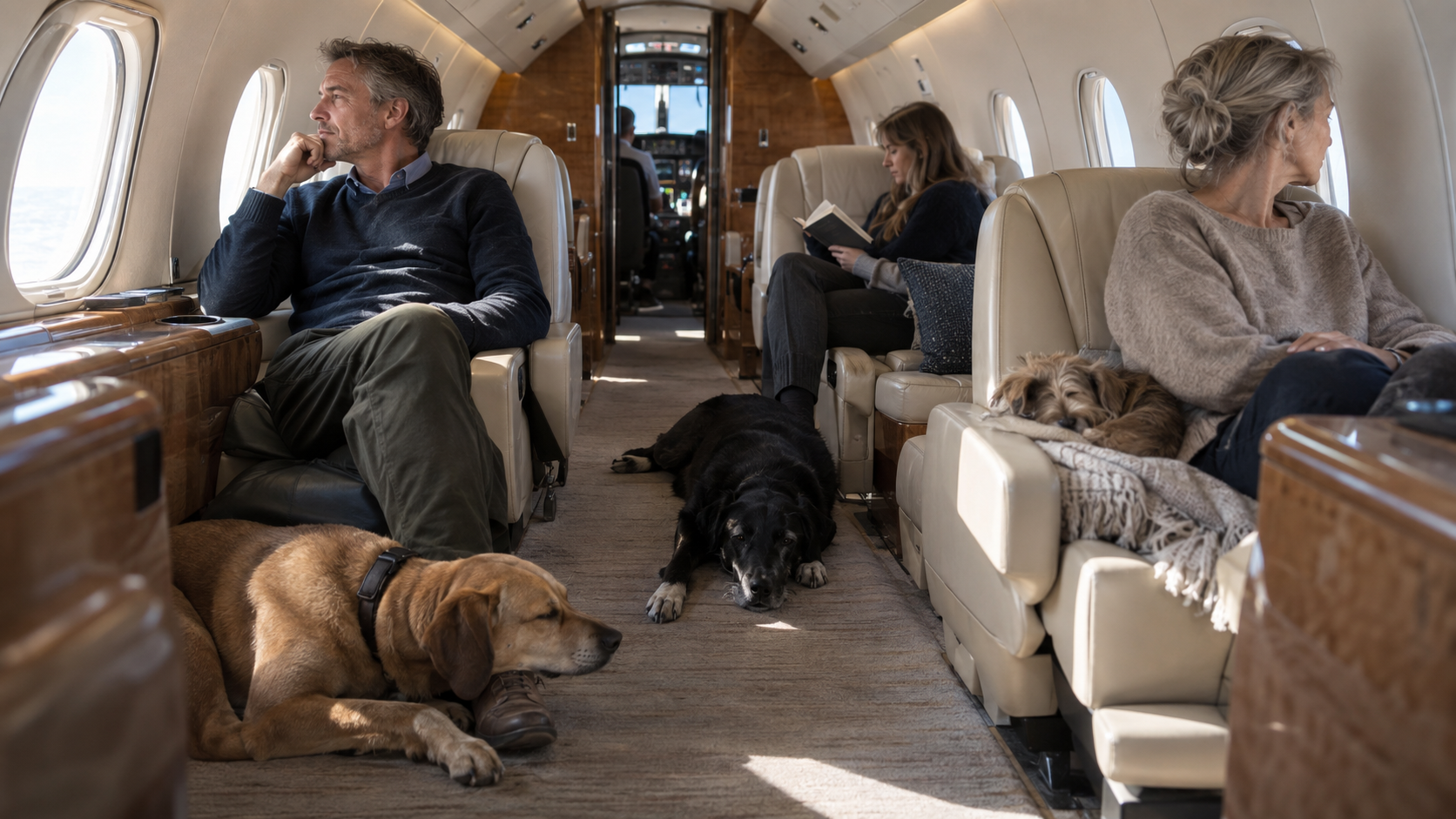
The cost of a flight sits almost entirely with the aircraft, not with the people inside it. Crew, fuel, parking, maintenance reserves, handling at both ends — those land the moment the aircraft moves. Whether two people are on board or eight barely changes them.
The whole model follows from that asymmetry. A private jet flying half empty isn't carrying empty seats. It's carrying undistributed cost.
What a shared flight is
A shared flight is one aircraft, one route and several travellers splitting the cost. The unit being priced is the seat, not the aeroplane.
The decisive difference from scheduled aviation is how the route comes into existence. There is no timetable establishing in advance that this city pair flies on Tuesdays at eleven. A route exists because someone opened it, and it becomes viable once enough seats are taken. Until then it is an open route, not a departure.
That sounds less finished than it is — but it is more honest than the alternative. A provider who presents a journey as settled before it is has only moved the risk to a later date.
A journey is confirmed when two things hold: enough seats are taken for the flight to carry itself, and the operator and aircraft are fixed. Until both are true, a reservation is a reservation.
Who is actually flying
One thing platforms like to blur belongs at the front: SkySociety is not an airline. We hold no air operator's certificate, we own no aircraft and we operate none.
Every journey is flown by a certified operator. They hold the approvals, employ the crew and carry responsibility for the safety and conduct of the flight. What a platform does is organise the journey: the route, the travellers, the animals, the documents, the day itself.
Anyone who wants to know who they're flying with should understand that separation — with any provider, not just this one.
Why dog owners are an unusually logical travel community
Shared travel works best where several people have the same unusual requirement and fail at it individually.
With dog owners that is true with remarkable precision. Anyone wanting to take a dog over eight kilograms long-haul finds almost no route through scheduled aviation. Chartering an entire aircraft is, for one person and one dog, disproportionate in most cases. For a long time there was nothing between those two poles.
There is also a side effect you only notice once you've seen it: in a cabin where everyone has a dog, a dog isn't something the other passengers have to tolerate. He's the reason everyone is sitting there. That changes the atmosphere on board more than a description suggests.
One guest wrote in her account that the dogs were able to meet each other in the terminal rather than first encountering one another in a confined cabin. It's a small detail. It is also exactly the difference between a cabin that permits animals and one that was arranged for them.
The one case it doesn't suit
There is a flip side to that, and it deserves saying. Dogs who react to other dogs are worse off in a cabin full of them than almost anywhere else. For those animals a shared flight isn't the cheaper version of the same product — it's the wrong product.
That is one of the cases where a charter isn't luxury but simply the correct answer, and it is worth raising before a booking rather than after one.
The difference from charter
A charter is the whole aircraft. The aeroplane is what's priced, not the individual seat, and with it the timing, the routing and the cabin belong to the group that pays.
That is the right answer when a journey genuinely needs the aircraft: a fixed date that cannot move; a group large enough to fill the seats anyway; a route nobody else wants to fly. And a dog who needs the cabin to himself — because he reacts to other dogs, because he is very large, or because he simply travels better alone.
The price difference is considerable, but the logic is simple. On a shared flight you pay a share and accept a fixed route, a fixed date and fellow travellers. On a charter you pay for the aircraft and get control of all three.
Why these routes are flown directly
One feature of shared private flights is rarely explained, though for anyone travelling with an animal it may be the most important: they go from A to B, with no hub in between.
Scheduled aviation is built around connecting airports, because that is how a small number of aircraft generate a large number of connections. A privately flown flight carries no such obligation. It flies the route it was booked for.
For a person that is a time saving. For a dog it is something else. On the cargo route, a connection means a second complete handling chain: unloaded again, waiting again, loaded again, often in an unfamiliar climate. And it is the point at which journeys fail outright — when a particular airport cannot through-check animals in the hold, for instance.
This property belongs to private aviation generally rather than to the shared model specifically. But it is the reason a shared flight solves more than a cost problem for dog owners.
What a shared flight can't do
The limits belong in the explanation, or it isn't one.
A shared flight is not flexible. Route and date are set; if you want to leave two days later, you need a different journey. The cabin is shared, with people and animals you didn't choose. The number of places is limited, and on journeys with animals it is often smaller than the aircraft's seat count suggests.
And not every route comes together. A route that attracts too few travellers stays open — sometimes permanently. That is the price of not inventing routes that don't exist.
Anyone who can't live with that is better served by a charter. That isn't a deflection; it's the accurate recommendation.
How a route comes into being
Which leaves the question of what happens when the connection you want simply isn't there.
Then it can be opened. Someone names a departure point, a destination and a rough timeframe, and demand for that specific route is pooled. If enough travellers appear, a flight forms. If they don't, none does — and that gets said plainly.
Routes take shape this way that no timetable would ever carry, because they are too small for scheduled aviation and too expensive for a single charter customer. Europe to the Gulf with dogs on board is one of them.
What to judge the model on
Jet sharing isn't a luxury product that happens to be cheaper. It's a response to a cost structure — and to the observation that some journeys cannot happen on scheduled flights and are out of reach as a full charter.
So the useful question to ask a provider isn't how exclusive their offering sounds. It's this: when exactly does my journey count as confirmed, who operates the aircraft, and what happens if the route doesn't come together?
Get clear answers and you know where you stand. Don't get them, and keep asking.
See what's currently open
The flight search shows the routes other travellers have already opened, with how far along each one is. If yours isn't there, you can open it yourself.