Flying with dogs
Pugs, bulldogs and aviation: why flat-faced dogs need a plan of their own
Pugs, French bulldogs and other flat-faced breeds meet restrictions in air travel that other dogs never encounter. What lies behind them, what the data shows, and what owners should discuss with their own vet.
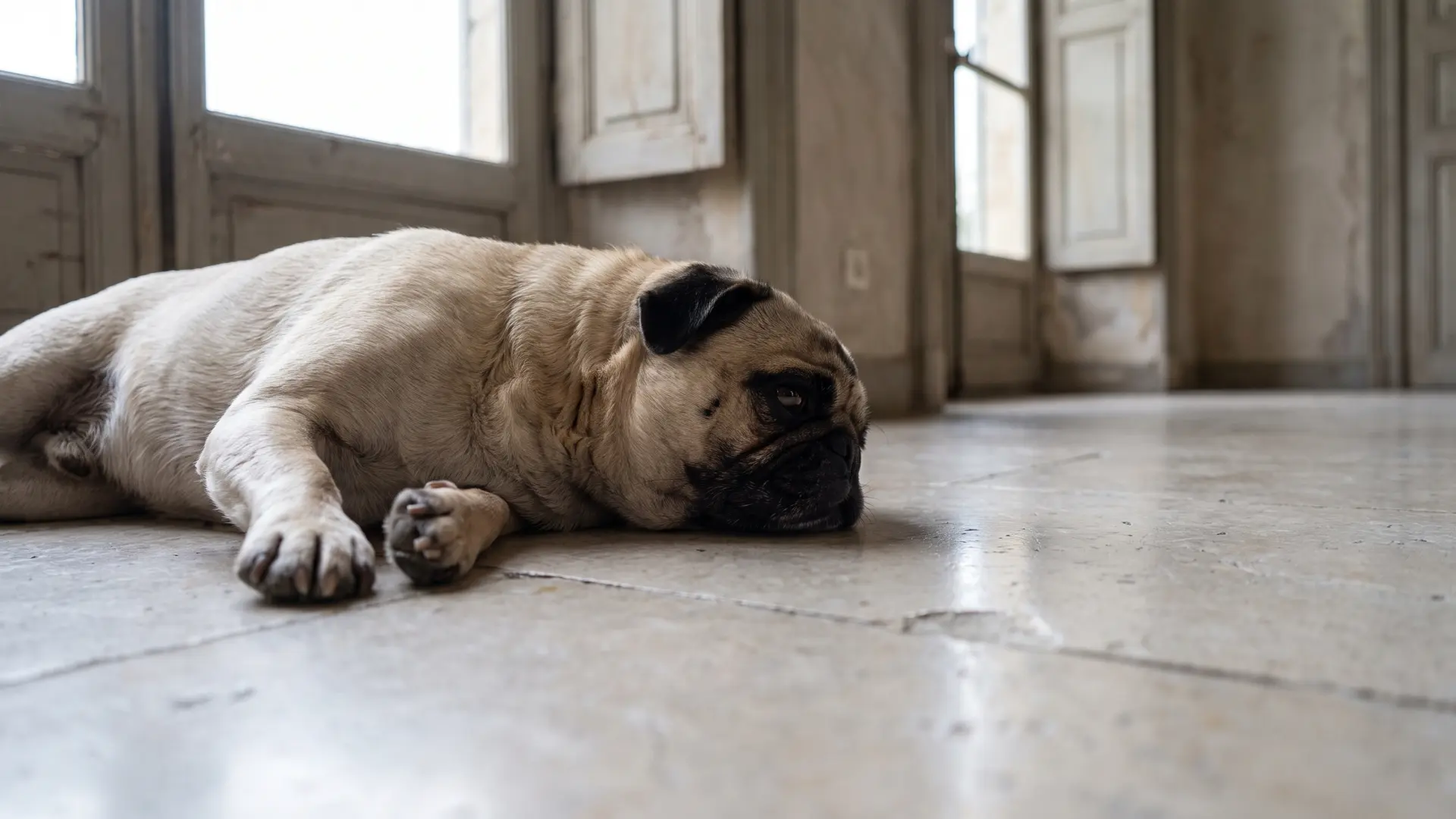
A pug weighs eight, nine, sometimes ten kilograms. Most airlines cap the cabin at eight kilograms including the bag. Depending on the dog, that is two to four kilos too many — not much, but enough.
So the hold it is. Except that many airlines explicitly exclude flat-faced breeds from the hold. Lufthansa, for one, does not carry them there at all.
Two kilos too heavy for one route, ineligible for the other. It is one of the few situations in travel where two entirely reasonable rules combine into a dead end.
Why the restrictions exist
The exclusions are not arbitrary. They are a response to data.
The American Veterinary Medical Association, citing US Department of Transportation figures, reported that flat-faced breeds such as bulldogs and pugs accounted for roughly half the dogs that died during cargo transport on US airlines. Their share of the dog population is considerably smaller. When one airline after another removed these breeds from hold transport, that was the reasoning.
The anatomy behind it can be explained without jargon. Flat-faced dogs have the same structures as other dogs — nasal passages, sinuses, a soft palate — with less room for them. Narrowed nostrils, an elongated soft palate or a narrowed windpipe are common findings. Where these features combine and noticeably obstruct breathing, veterinary medicine calls it brachycephalic obstructive airway syndrome, or BOAS.
What matters for flying is the consequence. Dogs cool themselves mainly by panting, and panting is respiratory work. A dog whose airways are already narrow cools less efficiently — and has to work harder simply to breathe when it gets warm or when he is agitated. Heat and stress arrive at the same already-loaded system.
Which is why airline heat embargoes for these breeds are stricter than for other animals; British Airways, for instance, is cited with a lower temperature ceiling for snub-nosed breeds than for animal transport generally. And it is why the critical phase is not the cruise, but the parts that are hot and loud: the apron, the handling area, the waiting.
What that doesn't mean
It doesn't mean flat-faced dogs can't fly.
It means part of the usual reserve isn't there. A labrador with clear airways absorbs a warm hour on the apron. For a dog whose breathing is audible at rest, that same hour can end differently. That is the whole difference — and it is a difference in planning, not a verdict on a breed.
Nor does it mean all flat-faced dogs are alike. The range within a single breed is wide: there are pugs with comparatively open airways and French bulldogs who are working audibly on an ordinary walk. A rule that has to be applied at a desk in seconds cannot capture that. A vet examining the animal can.
Why every airline says something different
Put several airlines' policies side by side and no common line emerges — which is one of the more maddening parts of the research.
Even the question of which breeds count as flat-faced gets different answers. Pugs and French and English bulldogs appear on essentially every list. Boxers, shih tzus, pekingese and Boston terriers are classified inconsistently. Some lists include crossbreeds with the relevant head shape; others don't.
On top of that sit rules that have nothing to do with breed but override it anyway: seasonal heat embargoes that close out whole summer months, airports where animals in the hold cannot be through-checked, per-flight quotas. A route can fail because one connecting airport in the chain doesn't cooperate.
In practice: there is no such thing as guidance on "flying with a pug". There is only guidance on a particular breed, on a particular route, with a particular operator, in a particular month. Research anything more general and you are researching past your own journey.
The questions that belong in the consulting room
None of this replaces a veterinary assessment, and it isn't trying to. What it can do is make the conversation better. These questions tend to get further:
How would you describe my dog's airway situation at rest and under exertion? Is there any indication of BOAS, and if so, to what degree? How does he handle warmth — judged on what you know about him, not on the breed in general? Are there cardiac or respiratory findings that would matter on a longer journey? What would you advise against for him specifically? And if you are certifying fitness to travel: what exactly does that cover, and what does it not?
One point takes priority over the rest. Veterinarians and animal welfare organisations agree in advising against sedatives for air travel: they affect circulation and breathing, may act differently under flight conditions than at home, and a sedated animal can no longer improve its own position. For a dog whose airways are already narrow, that weighs more heavily than for others. What is defensible in an individual case is a decision only for the vet who knows the animal.
What you can still influence on the day
Between what can't be changed about a dog and what happens on the travel day lies a surprisingly wide strip that owners control themselves.
Timing counts most. A departure in the early morning goes differently for a heat-sensitive dog than one in the early afternoon — not because of the cabin, but because of the routes to it: car park, apron, waiting. Where there's a choice, the coolest part of the day is the best one. And at the height of summer, whether the journey can move at all is a more serious question than which provider operates it.
Then the dog's state on the day itself. A dog already panting with excitement before you set off starts with less reserve. A calm walk beforehand, enough time instead of rush, no heavy meal close to departure, and water in small amounts are the unglamorous measures that actually work.
Finally the harness. A chest harness distributes pull differently from a collar, which on a flat-faced dog bears down exactly where there is already little room. Many owners switch for travel. What suits your own dog is worth settling in advance — not in the terminal.
What a different kind of flying changes — and what it doesn't
A private flight removes the part of the journey that suits these dogs least: the hours of waiting in handling, the drive across a hot apron in a crate, the separation from their person, the whole sequence repeated at a connection. Distances are short, the dog stays in the cabin, and the time between car and aircraft is measured in minutes.
For a flat-faced dog, that isn't a comfort question. It is precisely the phase in which his anatomy counts.
What it does not change is his airways. A private flight does not turn a dog with pronounced BOAS into an unproblematic passenger, and there are animals for whom the right answer is to travel differently, or not at all. Operators assess animals on board against their own criteria too; a yes is not automatic because the aircraft is private.
What such a journey can look like when it is well prepared was described by a guest who flew from Munich to Dubai with her pug in 2025. Her dog lay at her feet during the flight and slept. What is notable isn't the comfort. What is notable is how uneventful it was.
The honest conclusion
For flat-faced dogs, flying isn't a question you answer with a number. The breed alone says too little, the cabin limit says something other than what it appears to say, and airlines' hold rules don't agree with one another.
What remains is an order of operations. First the veterinary assessment of this dog. Then the question of which form of travel genuinely lowers his load — not which one feels better. Only then the route, the provider and the date.
Work in that order and you sometimes conclude that the journey waits. That is also an answer, and not a bad one.
Talk it through beforehand, not on the day
If you're planning a route with a flat-faced dog: speak to your vet first, then to us. We'll tell you what's possible on your route — and if it doesn't work for your dog, we'll say that too.