Flying with dogs
Flying with a large dog in the cabin: why eight kilos is the number that decides everything
Eight kilograms including the carrier: that is where the cabin ends for most dogs. Where the limit comes from, what the alternatives are, and why one European airline broke with it in 2026.
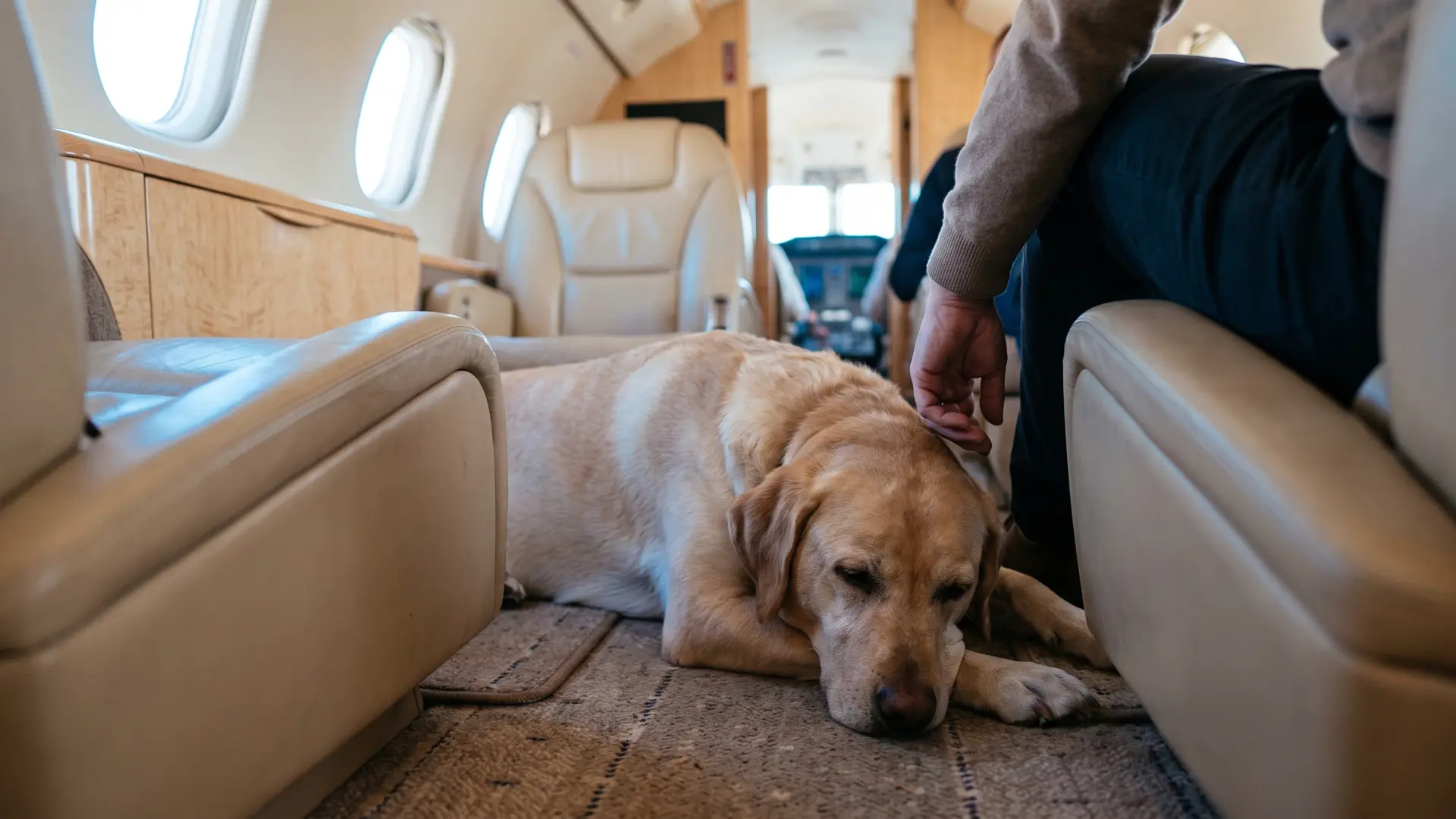
There is a moment almost every dog owner planning a flight recognises. You open an airline's animal policy, find a number — eight kilograms, carrier included — and do the arithmetic. Then you do it again, because the first answer can't be right.
A pug weighs a good eight kilos. A travel bag weighs one or two. A beagle is around twelve, a cocker spaniel thirteen, a labrador thirty. Which means the limit does not separate large dogs from small ones. It separates very small dogs from everybody else.
Where the number comes from
Not from legislation. No European regulation sets eight kilograms, and no international authority draws that line. It is a condition of carriage, and it follows from something entirely mundane: the space under the seat in front of you.
A dog travels in the cabin as an additional piece of hand luggage. He has to stay in a closed bag for the whole flight, and the bag has to go where a rucksack would otherwise sit. Everything else follows from that. Lufthansa specifies a maximum of 55 × 40 × 23 centimetres and eight kilograms including the animal; the bag has to be sturdy and leak-proof, and the dog has to be able to stand, turn around and lie down inside it. Other airlines land slightly above or below, but the order of magnitude is the same across the industry — six to eight kilograms is typical.
Above a certain size, incidentally, those conditions contradict each other. A bag in which a twelve-kilo dog can stand upright and turn around no longer fits under a seat. That is not a drafting error in the rules. It is the reason the limit exists.
There is a second restriction that gets mentioned less often: the headcount. Lufthansa allows a maximum of two animals in the cabin per flight. So a dog who meets every dimension can still find no space because two others were quicker. Travel with two dogs and you may have taken an entire flight's allocation; travel with three and there is no option left at all.
What the rule doesn't measure
What is striking about the eight-kilo limit is what does not appear in it: the dog.
A calm twelve-kilo crossbreed who sleeps six hours beside his owner is not carryable under this rule. An anxious seven-kilo terrier pushing against the zip the whole way is. The number describes the space under a seat, not the temperament or condition of the animal in it.
That is not a criticism of airlines. A rule that has to be applied at a desk, in seconds, to millions of passengers cannot accommodate individual cases. But it does explain why the rule feels wrong to so many owners. It isn't describing the problem they actually have.
There is one exception. Assistance and guide dogs fall outside the cabin weight limit; as working dogs they are carried under separate procedures, usually without a carrier and without a fee, but with documentation and advance notification. That is a process of its own, not a back door for family dogs.
What happens above the limit
If the dog doesn't fit in the cabin, the scheduled-airline route leads to the hold. Animals travel there in a separate, temperature-controlled and pressurised compartment, in containers built to the IATA Live Animals Regulations, booked through the airline — often with a deadline of 72 hours before departure.
It is an established route, and many dogs arrive without incident. But it comes with conditions that only surface when you read closely, and those conditions are not met by every combination of airline, airport and breed.
Two examples from a single airline's rules make the point. Lufthansa does not carry flat-faced breeds in the hold at all. And on connections routed through Munich, animals in the hold cannot be through-checked — so that route closes for those itineraries regardless of breed.
An owner with a pug who would have to connect in Munich is therefore facing two shut doors at once. That is exactly the situation described by a guest who moved to Dubai in 2025: too heavy for the cabin, ineligible for the hold as a flat-faced breed. Her entire relocation hung on how a dog flies.
Heat embargoes sit on top of this. Many airlines will not carry animals in the hold when outside temperatures exceed a given threshold at any point along the itinerary. On European summer schedules and on routes into the Gulf, that is not a theoretical restriction.
What changed in 2026
And then there is a development that moves the picture.
ITA Airways has become the first European airline to carry substantially larger dogs in the passenger cabin. The basis is a rule issued by the Italian civil aviation authority ENAC in late 2025; the service became bookable on 3 August 2026. Dogs between ten and thirty kilograms travel not in the footwell but in their own pre-booked seat beside their owner.
The limitations matter as much as the headline. The service starts on selected Italian domestic routes, and the number of animals per flight is tightly capped at first — two large dogs and two animals up to ten kilograms are the figures given.
For someone wanting to take a German shepherd from Düsseldorf to Dubai, none of that helps yet. As a directional signal it is still notable, because it shows the eight-kilo limit is not a law of physics. It is a rule — and rules move when a regulator moves with them.
What is different in private aviation
Private aviation has no universal weight limit for dogs in the cabin. That is less generosity than structure: there is no seat something must fit under, because the cabin is not divided that way.
What it does not mean is that every dog can fly on every route. The answer depends on the aircraft and how its cabin is laid out, on the operator's policy for animals on board, on the countries of departure and arrival, and on how a particular dog spends a particular flight duration. It also depends on whether a crate is required, and which one.
Anyone who gives you a number without asking about your route is guessing.
Which is why the more useful question isn't "how heavy can my dog be?" but "on which route, in which aircraft and under which conditions can this dog sit next to me?" That question can be answered per trip — before anyone pays for anything.
How to make the decision
Three things worth holding on to.
Read the specific airline's policy for the specific route, not a summary. Universal rules don't exist, and summaries date quickly.
Check the whole itinerary, not just the departure. A connection can rule out carriage that a direct flight would have allowed.
Keep carriage and entry separate. An airline decides whether your dog may be flown. Border authorities decide whether he may enter. Both have to hold, and both are assessed independently.
What's left is an uncomfortably simple conclusion. For dogs over eight kilograms, the cabin on scheduled flights is currently the exception rather than the rule. An owner who still wants their dog beside them has to change the kind of flying, not the airline.
Have it checked for your dog
Tell us the breed, the weight and the route. We'll tell you which aircraft can carry him — and whether the journey works for your dog at all.