Comparison
Cabin or cargo: what dogs on long-haul flights actually have to choose between
Cabin, hold or private flight: how the three routes actually look from a dog's side on a long-haul journey, what the evidence shows, what it doesn't — and what owners should decide on.
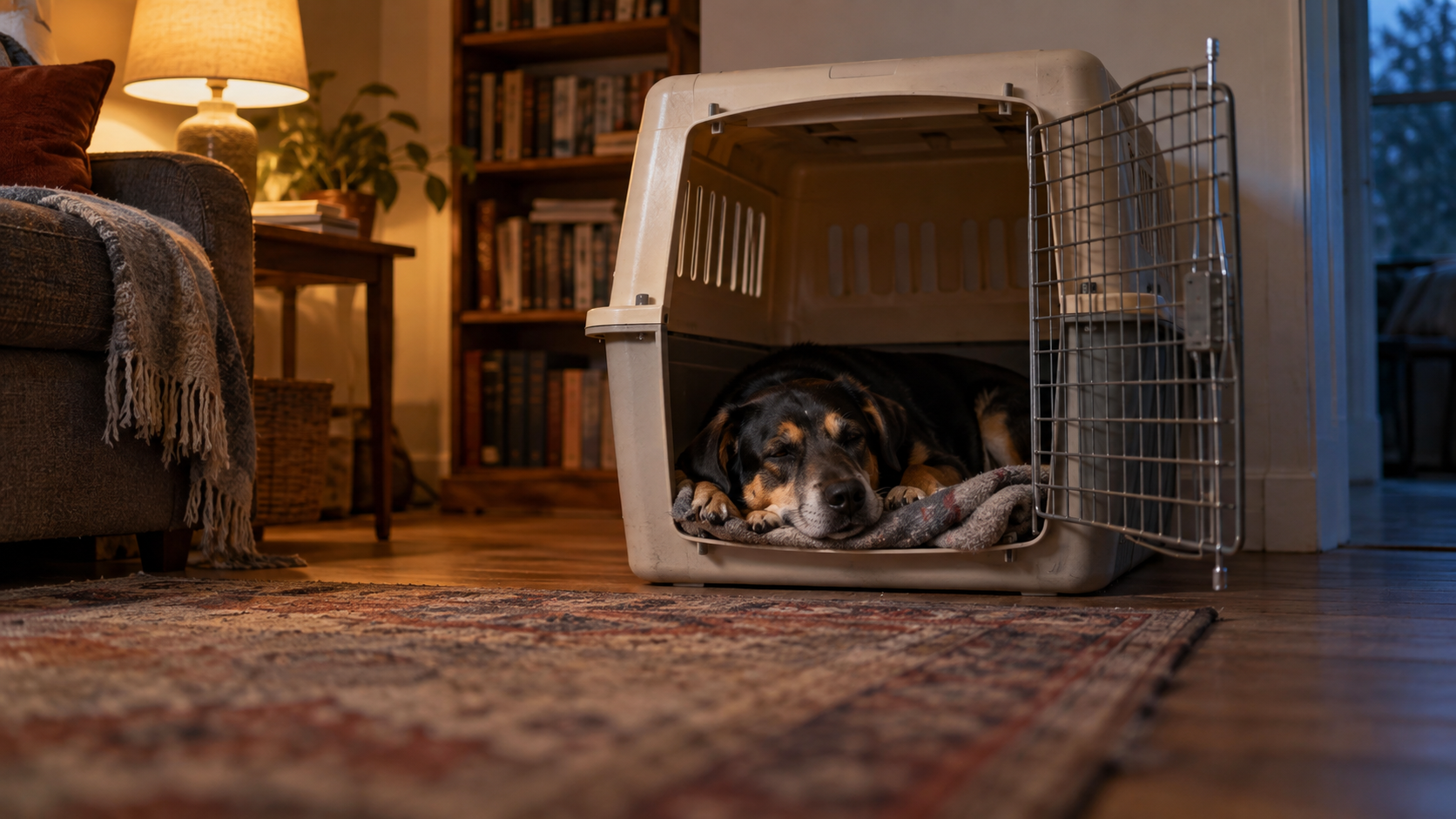
The hold is rarely written about calmly. Either it is a dark, freezing void where dogs suffer — the version you find in forums and in the marketing of companies selling an alternative. Or it is a routine, unremarkable procedure with nothing to discuss — the version you find in brochures.
Both are too simple. The difference between the routes lies less in the flight than in everything surrounding it.
What the hold actually is
Start with the physics, because that is what gets misrepresented most often. Animals do not travel in an unheated baggage bay. They travel in a dedicated compartment that is pressurised and temperature-controlled. Containers follow the IATA Live Animals Regulations, which set minimum dimensions relative to the animal: the dog has to be able to stand upright, turn around and lie down fully extended. Booking runs through the airline, usually with a 72-hour deadline.
So the flight itself is not what makes this route hard.
What makes it hard is the chain around it. The dog is handed over hours before departure. He waits in a handling area. He is driven across the apron, loaded, unloaded after landing, and taken to an animal reception facility. In Dubai, handlers routinely describe several hours between landing and handover to the owner — figures of roughly three and a half to five and a half hours are quoted, during which papers are checked, the chip scanned and the animal inspected. A connection adds a second chain of the same kind.
For an animal who last saw his people at a desk in Germany, that is the actual event. Not the cruise at eleven thousand metres.
Why this route exists at all
It is worth pausing on what the hold was built for, because that tends to disappear in the argument.
For a German shepherd moving from Hamburg to Singapore, scheduled aviation offers no alternative. For most intercontinental relocations it is the only way a large dog comes along at all — and it exists because tens of thousands of families need exactly that every year. An entire infrastructure has grown around it: animal transport agents, handling facilities at major airports, container manufacturers, rules governing minimum dimensions and ventilation.
Condemning that route wholesale means condemning the only option many owners have ever had. Which is not only unfair, it is useless as advice.
The crate is not a detail
One thing that is almost always missing from comparisons decides a surprising amount in practice: the container.
IATA sizing is set against the animal, not against a standard size — the dog must be able to stand, turn and lie out flat. Containers that fail this are refused at check-in, and then there is a dog at an airport who cannot fly. Ventilation openings are regulated too; for dogs they may not exceed a set dimension.
More important than the dimensions, though, is familiarity. A crate the dog sees for the first time on departure day is a cage. A crate he has been sleeping in voluntarily for weeks is a familiar place that happens to be travelling. The difference costs nothing but lead time, and it changes the journey for the animal more than the choice of airline does.
What the evidence shows — and what it doesn't
This needs care, because a great deal of fear marketing is built on these numbers.
What is documented: the American Veterinary Medical Association, citing US Department of Transportation data, reported that flat-faced breeds such as bulldogs and pugs accounted for roughly half the dogs that died during cargo transport on US airlines. Measured against their share of the dog population, that is a marked over-representation. It is precisely why many airlines exclude these breeds from hold transport — the restrictions are a response to data, not an arbitrary rule.
What does not follow: that the hold is dangerous for dogs in general. Set against the volume of animals carried, the absolute numbers are low, and a large share of documented incidents falls on a small group of especially vulnerable animals. Turning that statistic into a verdict on every dog misreads it.
A second point on which veterinarians and animal welfare organisations are notably aligned: sedatives are a poor idea for air travel. They affect circulation and breathing, their effect under flight conditions can differ from their effect at home, and a sedated animal in a crate can no longer shift itself into a better position. The standard recommendation is crate acclimatisation well in advance instead. What is defensible in an individual case is a decision for the vet who knows the animal — not for an article and not for a forum.
When the cabin is even on the table
On scheduled flights the cabin is open only to very small dogs. A limit of six to eight kilograms including the carrier is typical, alongside carrier dimensions in the region of 55 × 40 × 23 centimetres and a cap on animals per flight. Anything above that finds no place there, however calm the dog.
Then come the exclusions that close the route before the number even applies: some airlines will not carry flat-faced breeds in the hold at all, some connecting airports cannot through-check animals in the hold, and heat embargoes can rule out whole summer months.
For many owners this is the moment they realise they are not choosing between two options. They are discovering that neither one fits their journey.
The third route
Private aviation doesn't change the rules of scheduled flying. It changes the structure of the journey.
The dog stays with his person — in the terminal, on board, on arrival. There is no handover hours before departure and no reunion hours afterwards. There is usually no connection, because privately flown routes are flown directly. And there is no weight limit derived from the space under a seat, because that space doesn't exist.
What there also isn't is a guarantee. Whether a particular dog can travel in the cabin on a particular route depends on the aircraft, on the operator's animal policy and on the countries involved. And private aviation costs a multiple of a scheduled ticket — less on a shared flight than on a charter, but considerably more either way.
The honest sentence is this: it solves one specific problem, the separation and the chain around it. It does not solve every problem, and it is not the sensible answer to every journey.
What to decide on
Not the average dog. Yours.
Four questions get you further than any table. How does your dog handle confinement, noise and being alone — not in theory, but on the evidence you already have? Does he belong to a group with documented restrictions: flat-faced, very old, very young, cardiac? Can the route be flown directly, or does it need a connection and a second round of handling? And how long is the whole journey, from handover to reunion — not just the flight time?
Answer those four and you rarely need a comparison. The answer emerges.
And in the cases where it doesn't, the most reliable information is still the specific kind: which airline, which airport, which aircraft, which month. General statements about "the hold" help very little here. It doesn't exist as one thing.
Check the route specifically
If you want to know whether your dog can travel in the cabin on your route: tell us the breed, the weight, the route and the timeframe. You'll get an answer about your journey, not a general one.